The most excellent Betsy Bird has challenged her readers to create lists of what they consider to be la creme de la creme of that most beguiling of art forms, picture books. I’ve been ruminating over my list for the past couple of weeks, and this is the main quandary I’ve faced:
Do you make a list of The Best Books For Everybody (the books that all U.S. libraries generally carry, that are beloved by nearly all), or My Personal Favorites (the books that I just can’t live without)? ‘Cause there’s a big gaping divide ‘tween those two. I’ve decided to create a list that’s balanced between both notions.
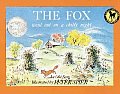 10. — Fox Went Out on a Chilly Night: An Old Song, illus. by Peter Spier. A mischievious fox. A New England farmer who waves his fist in the air at him. Gorgeous, well-researched period detail — check out the barn full of tobacco! How often do you see that in a picture book? — and a folk melody you just can’t resist. There’s always a bit of autumn snap in the air when I open this book, and by the end suddenly I crave roast goose.
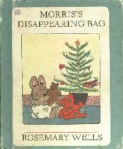 9. — Morris’ Disappearing Bag, by Rosemary Wells. Four siblings, Christmas morning. The big kids get cool presents (hockey stick, chem set, beauty kit) but little Morris is bestowed with naught but a lame-o teddy bear. When the big kids won’t play with him, Morris sulks — until he finds a forgotten present under the Christmas tree that makes everybody disappear. The fact that this book doesn’t come across as a disturbing revenge fantasy is testament to the picture-book writing prowess of early Wells. Sorry, Polar Express fans — this quiet charmer really is the ne plus ultra of Christmas books.
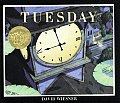 8. — Tuesday by David Wiesner. The iconic flying frogs! Ain’t nuthin’ says “good character design” like flying frogs. They whiz through the air like UFOs from a ’50s B-movie on those cute little lilypads! Creating a wordless picture book with great comic timing is more difficult than you think, and this most clever of Wiesner’s creations never fails to bring on a smile. Okay, I also admit: this book was also the one that first got me interested in contemporary children’s literature (yes, I was about fifteen at the time. Oh, and I was definitely at the top of my high school’s social pyramid, why do you ask?).
 7. — Freight Train by Donald Crews. It’s strictly 2-D, and overfloweth with white space. The text is comprised of sentence fragments. And yet, and yet . . . I’ve yet to see a toddler who doesn’t get excited to see it, a librarian who doesn’t insist on having it in her storytime bag, or a parent (me) who doesn’t get tootired of reading it repeatedly. There’s something mystifyingly Zen-ish about this book’s magical simplicity . . . if an orange box car, green cattle car, and a yellow hopper car go through a tunnel, and nobody’s around to hear it, will the two-year-old ask to hear it again? (And again and again and again . . .)
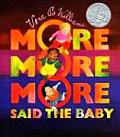 6. — More, More, More Said the Baby: Three Love Stories by Vera B. Williams. It’s almost the opposite of Freight Train in terms of design — there isn’t a speck of white anywhere in these book’s shimmering rainbow-hued pages, purposely so. It features mutiethnic families (still considered groundbreaking when it was published in 1990) and has a simple yet songlike text that nearly requires that tummies be tickled, toes nibbled, and small bodies rocked to sleep while reading it. Mmmm, said the reader. Mmm, Mmm, Mmmmm.
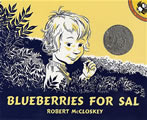 5. — Blueberries for Sal by David McCloskey. I’d like to see any illustrator today take up the challenge of producing a book with art created entirely out of blue ink, and still have it be as visually compelling and humorous as Blueberries for Sal. The story is a bit charmingly dated — if you can get your hands on a hardcover edition, check out the endpaper illustrations featuring Sal and her mother canning berries on a woodburning stove — but still as appealing to kids as ever. Even if, in reality, Sal probably would have been eaten right up by that bear.
 4. — St. George and the Dragon, retold by Margaret Hodges, illustrated by Trina Schart Hyman. This is one of those books where the spectacular illustrations tend to overshadow the text, howver high the quality may be. But let me just say: I’m still jaw-droppingly impressed by the job Hodges did in adapting Spenser’s The Fairy Queene for the elementary school set. (Think it’s easy? You try.) As for the Hyman pictures, well, they still make me stop in my tracks and want to stare at them for hours. Who can resist a book with turreted castles, English flora inhabited with fey folk, a smokin’ hot knight*, and one heckuva burninating dragon?
 3. — Why Mosquitoes Buzz in People’s Ears, retold by Verna Aardema, illus. Leo & Diane Dillon. The fact that two people manage to illustrate picture books together so seamlessly still manages to blow my mind. The fact that they can do it and make fabulously, modern-yet-timeless-looking jungle creatures that remind me of traditional Ashanti masks rendered in neon. Aardema’s retelling is tight and pretty much flawless; cumulative folktales such as this one run the risk of becoming tedious (it’s the reason I can’t stand “This is the House that Jack Built”) but her text is justrhythmic enough to stay lively through repeat read-alouds. Bonus: the “Lion” character gives you ample reason to channel your inner James Earl Jones.
 2. — The Story of Ferdinand by Munro Leaf, illus. Robert Lawson. It’s supposed to be the #1 international bestselling children’s book of all time. It’s also the book that Jella Lepman (founder of the IBBY and the International Youth Library) translated and made 30,000 copies of to give the children of Berlin, circa 1945 (take THAT, copyright law!). If those two facts alone couldn’t convince you of this book’s merit, then keep in mind that the message of sitting down to smell the flowers instead of fighting the matadors is still pretty darn relevant today. And you know those five men in the funny hats? Still darn funny, no matter how many times you see them.
 1. — Madeline, by Ludwig Bemelmans. Okay, okay, this book has landed la place premiere spot pretty much because I have gobs of personal childhood nostalgia lumped onto it**, but really: it’s a classic, the illustrations still as fresh and sophisticated today as ever, and the text may be a bit clunky-sing-song but sticks in your brain like gum to a shoe (“To the tiger in the zoo / Madeline just said “pooh-pooh!”). The big yellow hat . . . La Tour d’Eiffel . . . that bed with a crank and the oddly triangular Miss Clavel? C’est magnifique! Even better: the illustrations contain a glaring yet easily-missed mistake that children’s book nerds (comme moi) can have fun pointing out to other children’s book nerds (it’s the secret handshake we’ve never come up with).
That’s the list! Here are a few runner-ups I wish I could have included (but didn’t because they were either too suited to individual tastes, or simply not as stellar compared to the others on the list):
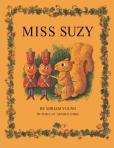 Miss Suzy by Miriam Young, illus. Arnold Lobel — it’s about a squirrel who, upon losing her home to bandits, goes to live in an abandoned dollhouse with a troop of toy soldiers. There’s just . . . SO many childhood fantasies being fulfilled in this book, I can’t begin to tell you how much I loved it as a kid. Best of all, it was reissued a few years ago in hardback, so I now have a pretty pretty copy for myself.
 The Clown of God by Tomie DePaola — Whenever I read this book, there’s a 99.99% guarantee that I’ll be crying at the end. See, it’s about this talented juggler during the Italian Renaissance, and when he grows old, nobody hires him anymore. Then on Christmas Eve he goes into a church to juggle . . . and TRUST ME it sounds STUPID in this summary, but it’s AWESOME. (*sob* I need to find a Kleenex . . . )
 The Mysterious Tadpole by Steven Kellogg — Plot: a kid’s tadpole-watching science project grows into a cheeseburger-eating Loch Ness Monster. What I love in this book is the lovely display of kid-type logic: yes, you can hide a 500-lb. monster under a carpet! And keep him in the junior high swimming pool all summer long! And nobody will notice him until they actually jump in the pool!
 The Country Bunny and the Little Gold Shoes by DuBose Heyward, illus. Marjorie Flack — A surprisingly progressive children’s book from the 1930s, about a little brown country bunny who wishes to grow up to be the Easter Bunny. When she ends up becoming the mother of 21 children, she’s told to give up this idea — but it turns out that her skills as a good parent are what enable her to fulfill her dream. And can you believe it was penned by the same guy who wrote the book for Porgy & Bess?
 Petronella by Jay Williams, illus. Friso Henstra — Williams was concocting “fractured fairy tales” long before it was fashionable to do so. This one’s my favorite of his sadly out-of-print titles. It features a princess who must go rescue a prince in order to inherit the throne. When she does so, she realizes that the fopheaded prince isn’t nearly as good a catch as the clever wizard keeping him prisoner. My husband and I have a theory that the reason Williams’ books didn’t catch on as they should have is because they all featured the weirdly psychedelic art of Friso Henstra. However, we both have a nostalgic fondness for his illustrations today — in this book, the illustration of the wizard with an axe for a head will implant itself into your mind and never, ever leave. (Proof that we are not the only ones who feel this way: originals of this book sell for $35 on Amazon.com, while used copies of the reissue — with its more traditional-looking fairy-tale illustrations — go for $3.95. And yes, this is the only image of this book I could find.)
 The Church Mouse and its many sequels by Graham Oakley — a British import, fully loaded with that nation’s distinctive brand of humor. Featuring a colony of mice who live in an Anglican vestry and Samson the cat, “who has heard so many sermons on Christian brotherhood that he has sworn off hunting mice.” The mice are lead by the street-smart Arthur and book-smart Humphrey (both equally dimwitted) and over the course of ten-odd books, they are rousted by a gang of rats, ousted by the vicar’s hippie summer replacement, kidnapped as part of the Wartlethorpe Moon Project, finagle Samson into a television ad campaign for cat food, and spend many hours at a time sunning themselves in the graveyard and snacking on wild berries. Still popular (and in print) in the UK, this is a series worth collecting.
Whew! That’s probably all the indulgence this list requires — I hope this inspires a trip to the library (or three)!
*By which I mean that he is dreamy . . . although, granted, he is literally on fire for a certain portion of the book.
**It’s the first book I ever had overdue at the library. I remember lying in my bed, unable to sleep, worried that the school librarian would bar me from checking out books ever again, until my mom explained what an overdue fine was. Aw, cute lil’ second-grader me.

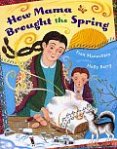 How Mama Brought the Spring by Fran Manushkin, illus. Holly Berry. A tidy story-within-a-story about a mother reminiscing about her childhood in Belarus, and how her mother would make golden, sizzling blintzes as a way to welcome spring. The story is a foodie’s dream (did I mention the flame-red cherry jam?) and the writing is peppered with language as charming and homey as artist Holly Berry’s accompanying folk-art-inspired illustrations. There’s a recipie for cheese blintzes in the back; Jeffrey loves this book so much that we decided to make them for dinner one night, which we did. He was so excited that he insisted I quote certain lines from the book as we went along — such as raising my fork at the dinner table and saying “Now! Eat in good health!” Which, mmmmm, we certainly did.
 The children’s book author Jon Sciezska once wrote that boys and fire are like iron and magnets: no matter what you do, somehow they will always find each other.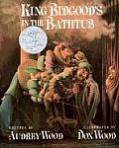
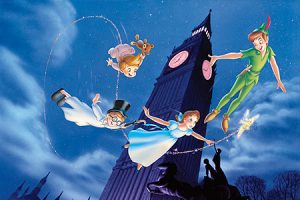 The local junior high is currently putting on a production of Peter Pan. A friend of mine has a son starring in it, and since she wasn’t able to attend herself (long story) she decided to buy and give away as many tickets as she could to show her support. Which is how I ended up with free tickets for me, Jeffrey, and Eleanor for a matinee today.
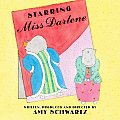 Starring Miss Darlene
 For Family Home Evening this past Monday, we decided to sit down with the kids and plan out our garden for the upcoming year. Brian and I are quite excited — the yard behind our house is huge, and Utah, with its lack of mold spores, fine earth, and sunny weather, is ideal for gardening (that is, if you can get the water).
 Casa Camisas